

Mould Removal NZ: The Complete 2026 Guide to a Healthy, Spore-Free Home
Stop throwing money at the landfill every time you see a black spot on your window frames. Most Kiwis believe that once those spores take hold, the only solution is a costly trip to the furnishings store, but that's a myth that costs NZ households thousands every year. Replacing a single set of floor to ceiling thermal curtains can easily top NZ$1,200, yet many are discarded prematurely. Effective mould removal isn't about masking the smell with bleach; it's about a scientific approach to spore eradication that saves your health and your wallet.
You're likely tired of waking up with a stuffy nose or feeling embarrassed when guests see damp corners in your lounge. We agree that your home should be a sanctuary, not a source of respiratory stress. This guide shows you exactly how to identify the root cause of dampness, treat existing growth with non-toxic methods, and implement a permanent prevention plan. We'll walk through the 2026 standards for creating a breathable, revitalised home that stays spore-free for good, using the same expert methods we use to save thousands of Kiwi homes every year.
Key Takeaways
- Understand how the high humidity in Kiwi coastal regions fuels fungal growth and how to create a breathable, dry environment.
- Protect your family from respiratory issues by identifying how mycotoxins accumulate in your home’s soft furnishings.
- Compare the effectiveness and costs of NZ professional remediation against standard "off-the-shelf" supermarket solutions.
- Master the essential safety protocols and the "No-Scrub" rule for effective mould removal without spreading spores further into your home.
- Discover the "Restore vs. Replace" philosophy to revitalise your expensive curtains and save them from the landfill using specialized formulas.
Understanding Mould Growth in the New Zealand Climate
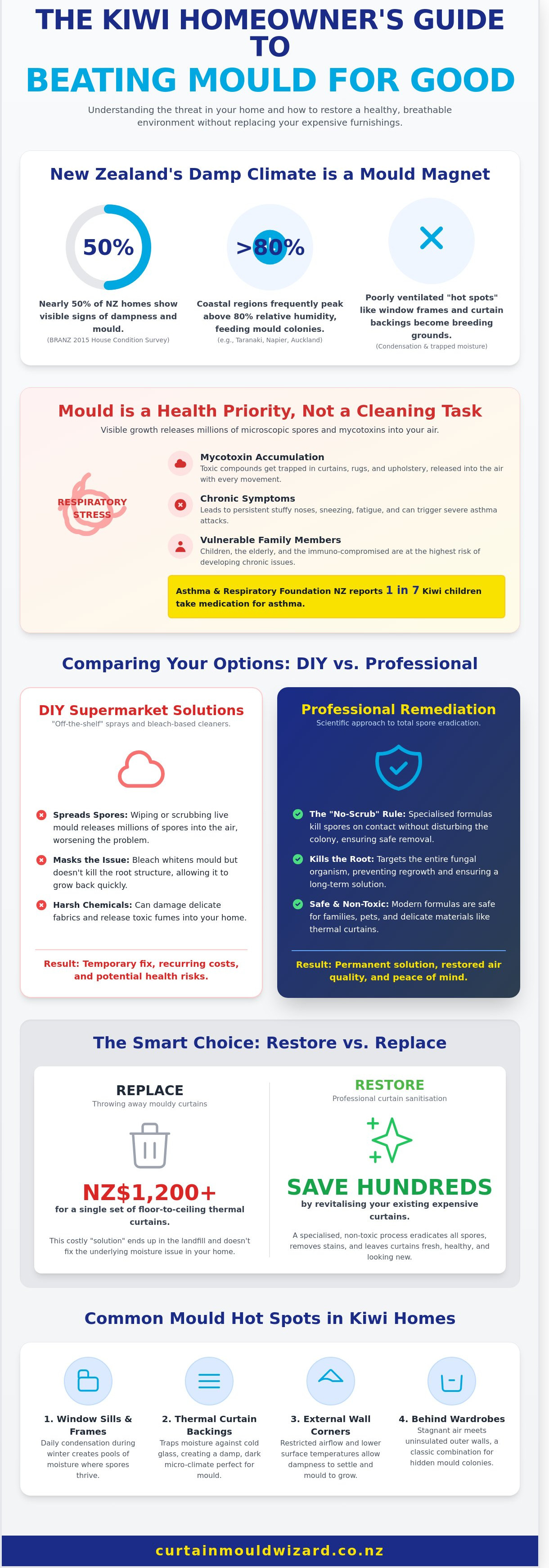
Mould isn't just an unsightly smudge on your wall; it's a living fungal organism that thrives on moisture and organic matter. In New Zealand, our temperate maritime climate creates the perfect incubator for these spores. Data from the BRANZ 2015 House Condition Survey indicated that nearly 50% of New Zealand homes showed signs of dampness or mould. High relative humidity, which frequently peaks above 80% in coastal regions like Taranaki or Napier, feeds these colonies. They settle in poorly ventilated spaces, turning your family home into a potential health hazard. Effective mould removal starts with identifying these moisture traps before the spores take root in your soft furnishings.
Common "hot spots" in Kiwi homes include:
- Window sills: Where condensation pools daily during winter.
- Thermal curtain backings: These trap moisture against cold glass, creating a damp micro-climate.
- External wall corners: Areas with restricted airflow and lower surface temperatures.
- Behind wardrobes: Where stagnant air meets uninsulated outer walls.
It's vital to distinguish between surface mildew and deep-rooted structural mould. Mildew is typically a grey or white powdery growth that sits on the surface. You can often wipe it away, though it will return if the moisture remains. Structural mould is more aggressive. It penetrates deep into porous materials like gib board or curtain fibres, making professional mould removal essential to save the item rather than sending it to the landfill.
Why Auckland and Northland Homes are Mould Magnets
Upper North Island residents face a unique battle against the elements. Sub-tropical weather patterns bring high humidity levels that rarely drop, even in summer. Auckland's older housing stock, specifically pre-1980s builds, often lacks the moisture barriers found in modern construction. This leads to the "weeping windows" phenomenon. When warm indoor air hits cold, single-glazed glass, it creates significant runoff. This constant moisture supply allows fungi to flourish on curtains and joinery, compromising your indoor air quality and requiring a specialized intervention to restore a breathable environment.
Identifying Different Types of Household Mould
Not all growth looks the same, and identifying the culprit is the first step toward sanitisation. Stachybotrys chartarum, commonly known as black mould, appears slimy and dark green or black. It's often linked to long-term water damage. You might also notice fuzzy green or white patches on organic fabrics or leather goods. It's a mistake to assume that colour determines toxicity. While black mould is the most famous, many white and grey species also release spores that trigger allergies. Our focus is always on total spore eradication, ensuring your home is revitalised and safe for every occupant.
The Hidden Dangers: Why Mould Removal is a Health Priority
Stop viewing those dark spots on your window frames as a minor cosmetic annoyance. Mould is a biological invader that actively colonises your living space. When you see visible growth, you're looking at a mature colony releasing millions of microscopic spores into your breathing zone every hour. In New Zealand, where the Asthma and Respiratory Foundation reports that 1 in 7 children take medication for asthma, effective mould removal is a vital medical necessity rather than a luxury cleaning task.
The real danger often hides within your soft furnishings. Porous materials like curtains, rugs, and upholstery act as filters, trapping "Mycotoxins" produced by species like Stachybotrys chartarum. These toxic compounds don't simply disappear when they dry out. They accumulate over time, meaning every time you draw your curtains, you're potentially puffing a cloud of toxins into the air. This constant exposure creates a "heavy" atmosphere that leads to persistent fatigue and respiratory irritation.
Don't overlook the psychological impact of living in a damp environment. A home that feels "dirty" or smells musty causes genuine mental stress and social embarrassment. You shouldn't have to hide your rooms from guests or feel anxious about your family's health. Professional sanitisation restores your home's hygiene, providing an immediate sense of relief and a breathable, fresh environment you can be proud of again.
Mould and Vulnerable Family Members
Children, the elderly, and those with compromised immunity face the highest risks. Their systems struggle to process high spore counts, often leading to chronic symptoms. Watch for persistent sneezing, runny noses, and unexplained skin irritation. The NZ Ministry of Health confirms that damp, mouldy homes are directly linked to increased hospitalisations for respiratory infections. Protecting these family members starts with total spore eradication.
Structural Damage and Property Value
Mould is a natural decomposer. It literally eats organic materials like timber, wallpaper, and natural fabric fibres. If you ignore mould on expensive thermal curtains, the fungi will eventually rot the lining, leading to structural failure of the material. In the current Auckland market, rental compliance is strictly tied to the Healthy Homes Standards, which require homes to be dry and well-ventilated. Neglecting mould removal doesn't just damage your health; it devalues your biggest financial asset. If your window treatments are starting to show spots, a specialised curtain restoration can save you thousands in replacement costs while ensuring your home meets local standards.
Comparing Your Options: Professional Remediation vs. DIY Solutions
Professional mould removal in New Zealand represents a significant investment in your property's health. For structural issues, professional remediation costs typically start at NZ$2,500 and can climb above NZ$15,000 if sub-floor ventilation or wall linings require replacement. Most Kiwis first reach for supermarket-grade sprays, but these "off the shelf" cleaners usually contain low-concentration bleach that only masks the problem. These formulas often fail to kill the root system of the fungus, leading to visible regrowth in as little as 14 days. This creates a cycle of frustration and wasted money.
The "Professional DIY" category offers a smarter middle ground. By using high-strength, specialized formulas designed for home use, you get the potency of a trade-grade product without the NZ$200 per hour labor costs. This approach also supports a "Restore vs. Replace" mentality. New Zealanders send an estimated 100,000 tonnes of textiles to landfills every year. Choosing to revitalise your existing furnishings instead of dumping them is a win for both your wallet and the environment.
When to Call a Professional Remediator
You should call in the experts if the mould growth covers more than one square metre. This is the standard threshold where airborne spore concentrations pose a serious health risk to occupants. If your home has suffered from structural leaks, rising damp, or major flooding, you need a specialist who follows IICRC S520 standards. These professionals use industrial HEPA filtration and negative air pressure to prevent cross-contamination during the mould removal process. Don't risk your health on major structural contamination; some jobs require heavy-duty trade intervention to ensure the building remains habitable.
The Smart DIY Choice: Saving Your Furnishings
Replacing custom window treatments is a massive financial burden. A single set of high-quality, floor-to-ceiling thermal drapes in New Zealand can cost between NZ$800 and NZ$2,500 per room. Why buy new when you can achieve a total transformation for a tiny fraction of that price? Our specialized "Curtain Wizard" formulas are engineered to outperform generic sprays, providing deep sanitisation that reaches into the fabric fibers.
- Save Time: Clean your curtains while they still hang on the rod.
- Save Money: Avoid the NZ$1,500+ bill for new custom drapes.
- Zero Risk: Prevent the fabric shrinkage often caused by commercial dry cleaning.
- Total Results: Eliminate black spots and musty odours instantly.
It feels like magic, but it's actually just superior chemistry. Taking control of your home hygiene with the right tools gives you the peace of mind that your living environment is breathable and fresh. It's the most cost-effective way to protect your family and your investment.
Step-by-Step Guide to Effective Mould Removal on Household Surfaces
Successful mould removal requires a tactical approach rather than brute force. Before you begin, equip yourself with the right kit to ensure your health remains the priority. You need an N95 or P2 respirator mask to filter out microscopic spores, heavy-duty rubber gloves, and wrap-around eye protection. Standard surgical masks don't provide the necessary seal against biological hazards. Proper mould removal is about containment as much as it is about cleaning.
The golden rule of home remediation is the "No-Scrub" policy. Don't use a brush or cloth to agitate dry mould. Scrubbing releases millions of spores into the air and pushes the fungal roots deeper into porous fibres or GIB board. Instead, rely on high-quality chemical reactions that dissolve the mould at a molecular level. This prevents cross-contamination to other rooms in your house.
Ventilation is your best friend during this process. Open all windows and doors to create a cross-breeze. Use floor fans to direct air outside, keeping them running for at least 4 hours after the treatment is finished. This ensures the indoor relative humidity drops below 60%, which is the critical threshold for fungal regrowth.
How to Clean Mould Off Curtains and Blinds
Curtains are delicate investments that require a specialized touch to avoid permanent damage. Follow these three steps to achieve a professional result at home.
- Step 1: Test a small, inconspicuous area on the reverse side of the hem for colourfastness. Wait 10 minutes to ensure the fabric dye remains stable.
- Step 2: Apply a specialized curtain mould remover directly to the affected area. Ensure the fabric is saturated so the solution reaches the backing.
- Step 3: Wait for the "magic" reaction to occur. You'll see the black spots vanish within minutes without any physical scrubbing.
For more detailed tips on saving your window treatments, read our guide on How to Remove Mould From Curtains Without Washing Them.
Treating Hard Surfaces: Walls and Ceilings
Treating overhead surfaces requires a specific technique to avoid chemical drips. Use the "backwards walk" method: spray the ceiling while moving backward so you stay ahead of the mist. For non-porous surfaces like bathroom tiles, a "wipe-off" method works perfectly. However, for porous surfaces like painted plasterboard, use a "leave-on" formula. These solutions penetrate the paint layer to kill the hyphae (roots) hiding inside the wall lining.
Once you've finished, use this post-cleaning checklist to ensure total eradication:
- Visual check: Are there any remaining dark specks or "ghosting" stains?
- Olfactory check: Has the damp, earthy "mould smell" completely disappeared?
- Tactile check: Is the surface dry to the touch within 24 hours?
Don't let spores take over your living space. If your window treatments are heavily infested, book a professional curtain restoration to bring them back to life safely.
The Restore vs. Replace Philosophy: The Curtain Wizard Way
Stop throwing your expensive curtains in the skip just because they've developed black spots. In New Zealand, our high humidity levels mean that almost every home faces a battle with fungal growth at some point. The Curtain Wizard philosophy centers on a "Restore vs. Replace" mindset, which saves Kiwi homeowners thousands of dollars in unnecessary replacement costs. Our proprietary formula is a professional-grade solution that doesn't just mask the problem. It targets the spore at the root to ensure complete sanitisation and spore eradication. This isn't a temporary fix; it is a deep-clean restoration that breathes new life into fabrics.
We've witnessed "landfill-ready" drapes from damp 1940s bungalows transformed into like-new condition in under fifteen minutes. By choosing restoration, you're participating in a more sustainable approach to home maintenance. Every set of curtains saved is several kilograms of textile waste kept out of New Zealand landfills. Our "Wizard" results provide that immediate sense of relief, turning a health hazard into a fresh, breathable asset for your living space. It's a smart financial investment that protects your health and your home's aesthetic value simultaneously.
Choosing the Right Container Size for Your Job
Selecting the correct volume ensures you have enough product to finish the job without unnecessary waste. Our 1L Starter Kit is the ideal choice for small bedroom window issues or isolated spots on thermal linings. If you're a landlord managing a turnover or you own a large Auckland villa with multiple floor-to-ceiling windows, the 4L or 20L options are far more cost-effective. These professional-grade removers feature a stable shelf life of approximately 24 months when stored in a cool, dark place. Having a larger container on hand allows for immediate treatment the moment a spot appears, preventing a small issue from becoming a full-blown infestation.
Beyond Cleaning: Preventing Mould from Returning
The most effective mould removal is the one you never have to repeat. Once you've restored your curtains to their original glory, you must change the environment that allowed the fungi to thrive. Follow these three practical steps to keep your home dry:
- Ventilation: Open your windows for at least 20 minutes every morning, even in winter, to flush out the moisture created by breathing and sleeping.
- Dehumidification: Use a dehumidifier in south-facing rooms to keep relative humidity levels below 50 percent, which is the "danger zone" for spore germination.
- Gap Sealing: Check the seals around your window frames. If cold air is leaking in, it creates condensation points where moisture pools on your fabric.
Maintaining a healthy home requires vigilance, but with the right tools, it doesn't have to be a struggle. Take control of your indoor air quality today and stop the cycle of damage. Shop our range of Curtain Mould Removers to start your restoration journey.
Take Control of Your Home’s Health Today
Living in the unique New Zealand climate means dealing with high humidity levels that frequently fuel spore growth. You now understand that effective mould removal isn't just about aesthetics; it's a vital health priority for every Kiwi household. By choosing the "Restore vs. Replace" philosophy, you're making a sustainable choice that keeps high-quality fabrics out of our landfills while saving significant costs on replacements.
Curtain Mould Wizard has operated as a family-owned NZ business since 2012. We've helped restore thousands of Auckland homes using our proprietary "No-Scrub" formula, which eliminates the frustration of manual cleaning. Our specialized approach ensures your window treatments are revitalized and your indoor air stays fresh. You can achieve professional results that protect your family's respiratory health without the stress of a full-scale renovation.
Restore Your Curtains Today - Shop Our Mould Removal Range
Take the first step toward a breathable, spore-free environment and reclaim the comfort of your home. You've got the tools and the knowledge to make it happen.
Frequently Asked Questions
Is mould removal safe to do myself at home?
Small patches of surface mould under 1 square metre are generally safe for homeowners to treat with proper protective gear. However, New Zealand health guidelines recommend professional mould removal for larger infestations to prevent cross-contamination. You risk spreading millions of invisible spores throughout your home if you disturb deep-seated growth without industrial-grade HEPA filtration and containment protocols.
How do I remove black mould from thermal curtain backings?
Treat thermal backings with extreme care because aggressive scrubbing peels the delicate acrylic coating. Apply a specialized non-scrub curtain cleaner directly to the spots and watch the magic happen as the black marks vanish. Our Restore vs. Replace approach saves you the NZ$500 to NZ$1,200 cost of new custom thermal drapes by safely eradicating the colony without compromising the insulation layer.
What is the best way to prevent mould in a damp Auckland house?
Reduce indoor humidity below 60% by using a dehumidifier and maintaining consistent airflow throughout the day. Auckland's average morning humidity often exceeds 80%, making mechanical ventilation essential for healthy homes. Open windows for at least 20 minutes daily and ensure your bathroom fans vent externally to prevent moisture from settling on cold glass and fabric surfaces.
Will mould remover damage the colour of my curtains?
Most retail products containing high bleach concentrations will cause permanent colour loss on natural fibres like linen or silk. Always perform a spot test on a hidden hem before starting any mould removal process. Professional-grade solutions are designed to target the fungi while leaving the fabric dyes intact, ensuring your revitalised curtains look as vibrant as the day they were hung.
Can I use white vinegar for permanent mould removal?
White vinegar effectively kills 82% of mould species, but it won't remove the stubborn black stains left behind on fabric. It serves as a temporary sanitisation tool rather than a permanent solution for porous materials. For a truly spore-free environment, you need a treatment that penetrates the fibres to eradicate the root system and prevent the colony from returning within weeks.
How long does it take for mould to grow back after cleaning?
Mould spores can begin recolonising a surface within 24 to 48 hours if the original moisture source remains unaddressed. Cleaning only removes the visible growth; it doesn't change the damp environment that invited the problem. Pair your cleaning efforts with improved insulation or moisture barriers to ensure your home stays fresh and breathable for the long term.
Do I need to wash my curtains after using a mould remover?
Wash your curtains thoroughly after treatment to rinse away dead spores and residual cleaning agents. Leaving dead organic matter in the fabric provides a food source for future fungal growth and can cause skin irritation. A professional rinse ensures the material is fully sanitised and safe for your family to touch, completing the transformation from musty to magnificent.
What health symptoms suggest I have a mould problem in my home?
Chronic sneezing, red eyes, and persistent skin rashes often indicate high spore counts in your indoor air. According to Asthma New Zealand, 1 in 7 Kiwi children are affected by respiratory conditions often triggered by damp, mouldy housing. If you notice a musty odour or wake up with a congested nose, your home's air quality likely requires an immediate hygiene intervention.